Search engine optimisation is sold with more vagueness than almost any other business service. Proposals promise authority, dominance and growth without ever specifying what will be done, what it costs, or when you should expect to see anything.
This guide is an explainer, not a pitch. It covers what SEO services in New Zealand genuinely involve, the retainer ranges being quoted in the market, what Google itself says about timelines, and how the arrival of AI Overviews has changed what “ranking well” is worth.
No agency is recommended, and where common industry claims don’t match Google’s own documentation, they’re corrected.
What SEO services actually cover
The work divides into four areas. Most providers do some of each, but the balance varies enormously — and knowing which one your site actually needs is the difference between a useful retainer and a wasted one.
This is making sure search engines can find, crawl, read and index your pages without obstruction. It covers site speed, mobile rendering, crawl errors, redirect chains, duplicate URLs, XML sitemaps and structured data markup.
Technical work tends to have a ceiling. Once a site is technically sound, more technical work adds little. It matters most for large sites, ecommerce catalogues with faceted navigation, and sites that have recently been migrated or rebuilt.
This is researching what people actually search for, then producing pages that answer those queries properly — with sensible titles, headings, internal links and a depth appropriate to the topic.
For most small New Zealand businesses, this is where the real work sits. It’s also the slowest and least glamorous part, which is why thin retainers often skip it in favour of technical reports that look impressive and change nothing.
This is earning links and mentions from other credible websites. Done properly, it means digital PR, genuine partnerships, industry directories and simply being worth citing. Done badly, it means buying links — which violates Google’s spam policies and creates risk rather than value.
For businesses serving a geographic area, this means claiming and maintaining your Google Business Profile, keeping your name, address and phone number consistent everywhere they appear online, gathering genuine reviews, and building local citations.
Map pack visibility often matters more to a plumber in Tauranga than national organic rankings ever will.
What SEO work actually covers
Most retainers include some of each. Ask which your site needs most.
| Area | What it involves | Matters most for |
|---|---|---|
| Technical | Crawling, indexing, speed, mobile rendering, structured data | Large sites, ecommerce, post-migration |
| On-page & content | Keyword research, page structure, writing genuinely useful pages | Almost every business |
| Off-page authority | Earning links and mentions from credible sites | Competitive national terms |
| Local SEO | Google Business Profile, citations, reviews, NAP consistency | Trades, clinics, retail, service areas |
Technical work has a ceiling — once a site is sound, more of it adds little.
What SEO services cost in New Zealand
There’s no official benchmark, but published NZ agency pricing in 2026 is consistent enough to plan against.
Monthly retainers for small and local businesses commonly sit between NZ$500 and NZ$2,500. Mid-sized businesses in contested categories are typically quoted NZ$1,500 to NZ$5,000. National ecommerce and enterprise campaigns run from around NZ$5,000 upward, sometimes well into five figures.
One-off work is priced separately. Technical audits range from a few hundred dollars for a light review to several thousand for a deep audit of a large site. Hourly consulting rates in New Zealand generally sit around NZ$150 to NZ$250.
SEO retainer ranges in New Zealand
Published market figures for 2026. Ranges overlap heavily — use them to sanity-check a quote, not to price a campaign.
| Business type | Monthly retainer (NZD) | Typically covers |
|---|---|---|
| Small / local | $500 – $2,500 | On-page work, Google Business Profile, basic reporting |
| Mid-sized / competitive | $1,500 – $5,000 | National terms, regular content, link building |
| National / ecommerce | $5,000 – $20,000+ | Large-site technical work, high content volume, CRO |
| One-off audit | $400 – $12,000 | Scope depends entirely on site size and depth |
Figures generally exclude GST (15% in New Zealand). Hourly consulting typically runs $150–$250.
Two things are worth noting. Quoted retainers usually exclude GST, which is 15% in New Zealand — factor that in when comparing proposals. And a meaningful share of the gap between an NZ$800 quote and an NZ$2,000 quote for similar scope is agency overhead rather than additional work, so ask what you’re actually buying at each price.
Be sceptical of both extremes. Very cheap retainers often buy automated reports and little else. Very expensive ones aren’t automatically better — ask how many hours a month you’re getting, and who is doing the work.
How long SEO actually takes
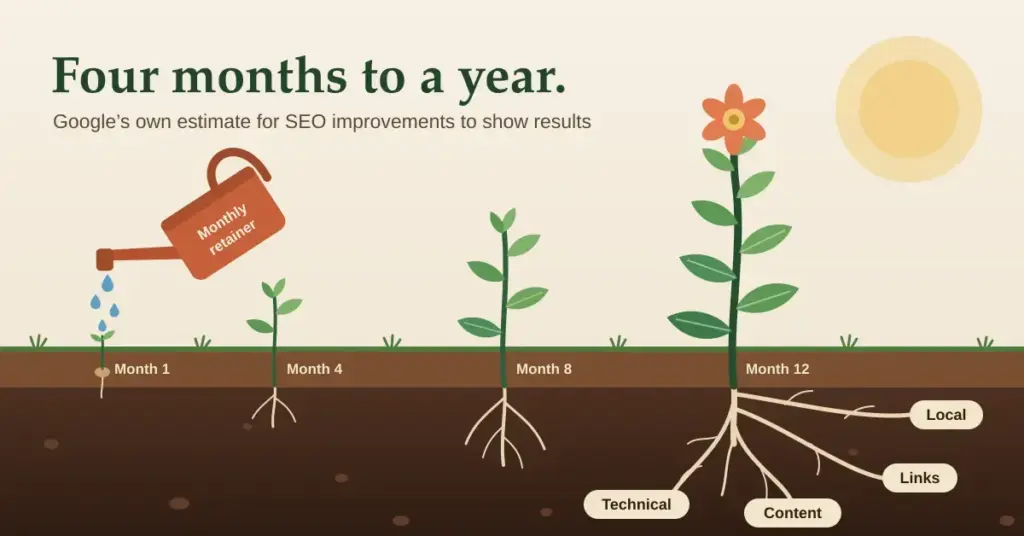
The most useful answer here comes from Google itself. In Google’s own guidance on hiring an SEO, Maile Ohye — then a Google Developer Programs Tech Lead — stated that in most cases an SEO will need four months to a year to first implement improvements and then see potential benefit.
That four-to-twelve-month window remains the realistic planning range. Within it, a few patterns hold.
Simple changes like title tags get recrawled and reprocessed relatively quickly. Larger strategic changes take considerably longer for Google to fully reassess.
New domains take longer than established ones. Google’s John Mueller has noted that rankings fluctuate more during a website’s first year while the algorithms work out where a new site belongs.
If a provider promises page-one rankings in six weeks, that’s a claim Google’s own documentation doesn’t support.
How AI Overviews changed the calculation
This is the most significant shift in organic search in years, and it’s absent from most SEO service pages.
A Pew Research Center analysis of roughly 68,900 Google searches, drawn from about 900 US adults, found that where an AI summary appeared, users clicked a traditional search result in about 8% of visits. Where no summary appeared, they clicked about 15% of the time — roughly half as often. Links inside the AI summary itself were clicked in around 1% of visits. Sessions ended after an AI summary 26% of the time, versus 16% without one.
A separate field study published in 2026 pointed the same way, finding a sharp fall in outbound organic clicks and a rise in searches that end without any click at all.
Google has disputed the methodology of some of this research, and reasonable people read the numbers differently. But the direction is consistent across multiple independent studies.
Here’s what it means in practice for a New Zealand business.
Ranking first is worth less than it used to be for informational queries. Pew found that longer, question-shaped searches trigger AI summaries far more often than short ones.
Impressions and clicks have decoupled. If Search Console shows steady impressions but falling clicks, that may not be a failure of your SEO — it may be the format of the results page.
Transactional and local searches are less affected. Someone searching for a builder in their suburb still needs to contact a builder. This is one reason local SEO and Google Business Profile work has held its value better than broad informational content.
Measure conversions, not rankings. Any provider still reporting primarily on keyword positions is measuring the thing that has become least connected to your revenue.
What Google actually means by content quality
You’ll frequently see “E-A-T” referenced on agency pages. That’s outdated. Google added a fourth E — Experience — in December 2022, making it E-E-A-T: Experience, Expertise, Authoritativeness and Trustworthiness.
More importantly, E-E-A-T is a framework in Google’s Search Quality Rater Guidelines, used by human raters to judge whether Google’s systems are producing good results. It isn’t a direct ranking factor with a score you can optimise. Google’s systems aim to reward the qualities it describes — which is a meaningfully different thing from measuring a number.
The practical version: content produced by someone with real experience of the subject, with clear authorship, accurate claims, and enough depth to actually answer the question.
For a New Zealand audience, that also means using local context correctly — referencing KiwiSaver, IRD and the FMA rather than importing 401(k) and IRS from overseas templates, and using New Zealand spelling consistently.
“Penalties”: what actually happens when things go wrong
The word “penalty” gets used loosely, and the distinction matters, because the recovery paths are completely different.
Manual actions are what Google’s documentation actually describes. A human reviewer at Google determines that pages violate the spam policies. You’re notified in Google Search Console under Manual Actions, and once you’ve fixed the problem you submit a reconsideration request.
Algorithmic demotion is different. Your rankings drop because Google’s systems have decided other pages are more helpful. There’s no notification, no reconsideration request, and no confirmation that anything is “wrong” — recovery comes from genuinely improving the site and waiting for reassessment.
Google doesn’t generally use the word “penalty” for the second case. If a provider warns you about “algorithm penalties” from cheap link building, what they’re describing is real — but the mechanism is a demotion rather than a sanction, and no one at Google will tell you it happened.
What SEO cannot fix
Being clear about the limits saves money.
SEO delivers visitors. It does not make a slow site fast, turn a confusing page into a persuasive one, or make an uncompetitive offer competitive. If your current site gets traffic and no enquiries, adding traffic multiplies a conversion problem rather than solving it.
Site speed sits in an awkward middle ground. It’s a genuine technical SEO concern, but it’s largely determined by your hosting and page performance rather than by anything an SEO provider changes in your content. Fixing the foundations first usually costs less than paying a retainer to work around them.
It’s also worth being honest about the trade-off with paid search. Organic results compound but take months. Google Ads delivers traffic within days but stops the moment you stop paying. Most businesses need some of both, weighted according to how urgently they need leads.
How to evaluate an SEO provider
The single most useful question is the least technical one: what specifically will you do in the first 90 days, and how will we know whether it worked?
A provider who can answer that concretely — naming deliverables and the metrics they expect to move — is worth more than one with a longer list of certifications.
Questions to ask, and answers to worry about
- What exactly will you do in the first 90 days? Deliverables, not adjectives.
- How many hours a month, and who does the work? Ask to meet them.
- What will you report on? Conversions and enquiries, not just rankings.
- How do you build links? If the answer is vague, keep asking.
- Do I keep the work if we part ways? Content, accounts and access should be yours.
- What’s the contract term? Six months is reasonable given the timeline; three years is not.
Warning signs
- Guaranteed rankings or guaranteed positions
- Results promised in weeks rather than months
- Reporting built around keyword positions alone
- A “special relationship” with Google — no such thing exists
- No access to your own analytics or Search Console data
If your site itself is the constraint rather than its visibility, our guides to WordPress hosting and website design in New Zealand cover the groundwork that has to come first.
This article is provided for factual and informational purposes only. It does not constitute professional, financial, legal or purchasing advice, and it is not a recommendation to engage any particular provider or strategy. Pricing, search engine behaviour and platform features change frequently — verify current details directly and seek qualified advice before making commercial decisions. For authoritative guidance, see Google Search Central on hiring an SEO.
Reference sources
- Pew Research Center — Google users are less likely to click when an AI summary appears
- Search Engine Land — Pew study on AI Overviews and click-through rates
- Search Engine Land — How long does SEO take to work
- Google Search Central — Do you need an SEO?
- Google Search Central — Creating helpful, reliable, people-first content (E-E-A-T)
- Google Search Central — Manual actions report
- Google Business Profile Help — Improve your local ranking
- MyBrandE — SEO pricing in New Zealand
- Horton Taylor — How much does SEO cost in NZ
- Consumer Protection NZ — Fair Trading Act guidance on misleading claims and reviews
Frequently asked questions
What do SEO services actually include?
Four areas: technical work so search engines can crawl and index your site, on-page content targeting what people search for, off-page authority building through links and mentions, and local SEO covering your Google Business Profile and citations. The right mix depends on your site and market — ask any provider which they’ll prioritise and why.
How much does SEO cost in New Zealand?
Published NZ retainer ranges in 2026 run roughly NZ$500 to NZ$2,500 per month for small local businesses, NZ$1,500 to NZ$5,000 for mid-sized campaigns, and NZ$5,000 upward for national or ecommerce work. Quotes usually exclude the 15% GST. Compare hours and deliverables, not headline prices.
How long before SEO produces results?
Google’s own guidance on hiring an SEO puts it at four months to a year to implement improvements and then see potential benefit. Small technical fixes can show sooner; competitive rankings and new domains take longer. Treat any promise of fast page-one results as a warning sign.
Have AI Overviews made SEO pointless?
No, but they have changed what a ranking is worth. Research shows click-through rates roughly halving on searches where an AI summary appears, and more sessions ending without any click. Transactional and local searches are less affected than informational ones, which makes local SEO and conversion tracking more important than raw ranking positions.
What is E-E-A-T, and is it a ranking factor?
It stands for Experience, Expertise, Authoritativeness and Trustworthiness, with Experience added in December 2022. It comes from Google’s Search Quality Rater Guidelines and describes what Google’s systems aim to reward — it isn’t a score you can directly optimise. In practice it means content written by someone who genuinely knows the subject, with clear authorship and accurate claims.
What happens if an SEO provider uses risky tactics?
Two possible outcomes. A manual action means a human reviewer at Google found a spam-policy violation — you’re notified in Search Console and can submit a reconsideration request after fixing it. An algorithmic demotion means Google’s systems simply rank you lower, with no notification and no appeal. The second is more common and harder to diagnose.
Should I do SEO in-house instead of hiring someone?
For content production and Google Business Profile upkeep, in-house is often perfectly workable and considerably cheaper. Technical audits, migrations and competitive link building generally benefit from outside expertise. A hybrid — external strategy and audit, internal execution — suits a lot of small New Zealand businesses better than a full retainer.