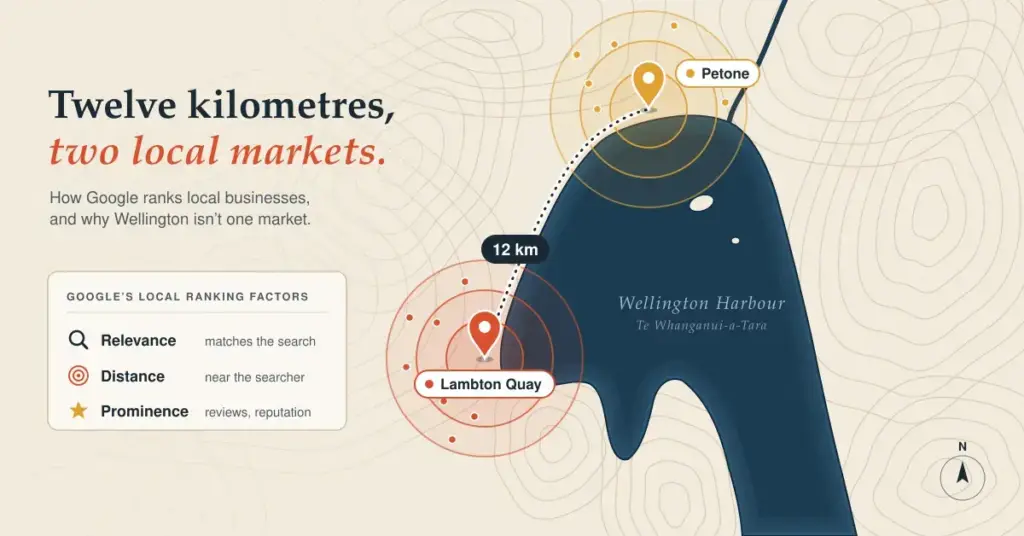
Local search behaves differently from national search, and Wellington’s geography makes those differences unusually sharp. A business in Petone and a business on Lambton Quay are twelve kilometres apart and effectively in separate local markets as far as Google is concerned.
This guide covers how Google actually ranks local businesses, what that means for a Wellington operator specifically, and one area — customer reviews — where common agency advice will put you on the wrong side of New Zealand consumer law. It’s an explainer rather than a pitch; no provider is recommended.
How Google ranks local businesses
Google publishes this, which is worth knowing because a lot of local SEO marketing implies the formula is secret.
Local results are based primarily on relevance, distance and prominence.
Relevance is how well your Business Profile matches what someone searched for. You improve it by giving Google complete, detailed and accurate information about what you do.
Distance is how far you are from the searcher, or from the location in their query.
Prominence is how well-known your business is — reviews, mentions, links and general visibility across the web.
What Google says drives local rankings
Straight from Google Business Profile Help — not a secret formula.
| Factor | What it means | Can you influence it? |
|---|---|---|
| Relevance | How well your profile matches the search | Yes — categories, services, complete information |
| Distance | How far you are from the searcher | No — this is geography, not optimisation |
| Prominence | How well-known your business is | Yes — reviews, mentions, links, citations |
Google may rank a more distant business higher if it’s a better match — but proximity still does real work in a city segmented like Wellington.
The one you cannot optimise is distance. No amount of retainer changes where your office is. That single fact should shape how you set expectations, and it’s the reason Wellington deserves its own treatment.
Why proximity bites harder in Wellington
Wellington’s commercial geography is unusually segmented for a city its size. The CBD is dense and narrow, the harbour splits the region, the hill suburbs are physically close but functionally separate, and the Hutt Valley and Porirua operate as their own markets.
The practical consequences:
A Lower Hutt business will struggle to appear in the local pack for a searcher standing on Willis Street, regardless of how good its SEO is. Google may rank a more distant business higher if it’s a better match, but proximity is doing real work against you.
Suburb pages don’t override proximity in the map pack. A page targeting “electrician Karori” can rank in ordinary organic results. It won’t put you in the three-business map pack for someone searching in Karori if you’re based in Newtown and a Karori competitor exists.
Where you verify your address matters more than most local advice admits. If you have genuine premises in the area you want to serve, that’s a structural advantage. If you don’t, service-area configuration in your Business Profile is the honest route — not a fictitious address, which breaches Google’s guidelines and risks profile suspension.
Public sector proximity is a Wellington-specific factor. Businesses selling to government agencies are competing on an entirely different axis: procurement processes, capability statements and B2B content, not map pack position. If that’s your market, weight your effort toward organic and content rather than local pack optimisation.
Google Business Profile: what actually moves prominence
Your profile is the highest-leverage asset in local search, and most of the work is unglamorous.
Choose your primary category carefully — it’s one of the strongest relevance signals available, and it’s the field most often left on a vague default. Fill in every applicable field: services, attributes, hours including public holidays, and a description that says what you actually do. Add real photos of your premises, team and work. Keep your name, address and phone number identical everywhere they appear online — your website, directories, social profiles and industry listings.
None of that is exciting. All of it is more effective than most of what gets sold as “local SEO strategy.”
Reviews — and the line you must not cross in New Zealand
Reviews feed prominence, so every local SEO provider will push you to gather more of them. This is where a lot of advice, including the earlier version of this page, crosses into practices that carry real legal exposure here.
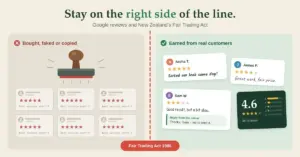
Review gating is the practice of surveying customers first, then sending happy ones to leave a public Google review while routing unhappy ones to a private feedback form. It’s widely sold as reputation management. It breaches Google’s review policies, and in New Zealand it now carries risk under the Fair Trading Act as well.
This isn’t theoretical. The Commerce Commission has treated review manipulation as an enforcement priority and has taken businesses to court over it:
Bachcare was prosecuted in 2019 and fined $117,000 for removing negative comments and withholding star ratings below 3.5 from display. The court found this created an artificially positive impression of its service.
Brand Developers, trading as The TV Shop, was convicted in the Auckland District Court in December 2025 on 13 charges after staff posted reviews without disclosing their affiliation, at the company’s direction and sometimes for reward.
Reviews: where the legal line sits in New Zealand
The Commerce Commission treats review manipulation as an enforcement priority under the Fair Trading Act.
| Practice | Status |
|---|---|
| Asking every customer for a review | Fine |
| Replying publicly to negative reviews | Fine, and recommended |
| Surveying first, then sending only happy customers to Google | Review gating — breaches Google policy, Fair Trading Act risk |
| Hiding or deleting low ratings from your own site | Prosecuted — Bachcare, $117,000 fine (2019) |
| Staff posting reviews without disclosing affiliation | Prosecuted — Brand Developers, 13 convictions (Dec 2025) |
| Rewarding reviews without clear disclosure | Breaches Google’s review guidance |
If a provider offers “automated systems for continuous five-star feedback”, ask exactly how customers are routed before signing anything.
What’s legitimate is straightforward: ask every customer, not a screened subset. Don’t filter by predicted sentiment. If you incentivise reviews at all, disclose it clearly and prominently. Respond to negative reviews publicly and calmly — a considered reply to a poor review often does more for a prospect reading it than the review itself does against you.
Any provider offering you “automated systems for continuous five-star feedback” is describing review gating. Ask them to explain exactly how customers are routed before you sign.
Schema markup and the star ratings myth
Structured data genuinely helps. LocalBusiness schema tells Google your coordinates, trading hours, phone number and service area in a machine-readable format, which supports the relevance side of the equation.
What it will not do is put review stars in your organic search listing. Google stopped displaying self-serving reviews in 2019 — meaning reviews about a business placed on that business’s own website, whether marked up directly or pulled in through a third-party widget. Google’s current review snippet documentation restates it: if the entity being reviewed controls the reviews about itself, pages using LocalBusiness or Organization structured data are ineligible for the star review feature.
So a plumber adding a 4.9-star aggregate rating to their own homepage gets nothing from it, no matter how valid the markup or how genuine the reviews. This remains one of the most common structured data mistakes on small business sites, and it’s frequently sold as a deliverable.
Google’s guidance also now explicitly prohibits fake or undisclosed incentivised reviews in page content and structured data — which lines up with the Fair Trading Act position above.
The website side
Local search still runs on a website, and two things matter most.
Speed and stability. Google measures real-world page experience through Core Web Vitals: Largest Contentful Paint at 2.5 seconds or less, Interaction to Next Paint at 200 milliseconds or less, and Cumulative Layout Shift at 0.1 or less, each at the 75th percentile of real visits. These are largely determined by your hosting and page weight rather than by anything an SEO provider edits in your copy.
Location pages that are actually different. A page for each suburb works when each page says something genuinely specific — different projects, different local considerations, different photos. Ten pages differing only in the suburb name is the pattern Google’s scaled content guidance describes, and it’s more likely to hurt than help.
On content quality generally: the framework Google’s quality raters use is E-E-A-T — Experience, Expertise, Authoritativeness and Trustworthiness, with Experience added in December 2022. It describes what Google’s systems aim to reward, rather than a score you can optimise directly. Any provider still writing “E-A-T” is working from pre-2022 material.
Cost and timeline
Published New Zealand retainers in 2026 run roughly NZ$500 to NZ$2,500 a month for small and local campaigns, and NZ$1,500 to NZ$5,000 for more competitive work. Quotes usually exclude GST.
On timing, the most reliable number comes from Google’s own guidance on hiring an SEO: expect four months to a year to implement improvements and then see benefit. Local pack movement can come faster than organic — a neglected Business Profile properly filled in sometimes shifts within weeks — but ranking work on the website side follows the longer curve.
One clarification on risk, since it’s usually described loosely. If something goes wrong, there are two distinct outcomes. A manual action means a human reviewer found a spam policy breach; you’re notified in Search Console and can submit a reconsideration request. An algorithmic demotion means Google’s systems simply rank you lower, with no notification and no appeal. The second is far more common, and Google’s documentation doesn’t call it a penalty.
A realistic local SEO checklist
- Set your primary category precisely. The most common easy win, and the field most often left vague.
- Complete every applicable profile field — services, attributes, hours including public holidays, real description.
- Match your NAP everywhere. Same name, address and phone number on your site, directories and social profiles.
- Configure service areas honestly if you travel to customers. Never use an address you don’t operate from.
- Ask every customer for a review. No screening, no filtering, no sentiment surveys first.
- Add LocalBusiness schema for hours, location and contact data — but don’t expect star ratings from it.
- Build suburb pages only where you have real, specific content for that suburb.
- Fix site speed before content spend. It’s a hosting and page-weight problem more than a copy problem.
Set expectations honestly: you can win your own catchment. You generally can’t win someone else’s map pack from twelve kilometres away.
For the broader picture beyond local search, see our guides to SEO services in New Zealand and local SEO for New Zealand businesses.
This article is provided for factual and informational purposes only. It does not constitute legal, professional or purchasing advice, and it is not a recommendation to engage any particular provider. The Fair Trading Act material here is general information about publicly reported enforcement action, not legal advice on your circumstances — seek advice from a qualified lawyer before implementing any review collection process. Search engine policies and NZ enforcement priorities change; verify current guidance with Google Business Profile Help and the Commerce Commission.
Reference sources
- Google Business Profile Help — Tips to improve your local ranking
- Google Search Central — Review snippet structured data guidelines
- Google Search Central Blog — Making review rich results more helpful
- ChannelLife NZ — New Zealand businesses warned over illegal review gating
- 1News — Infomercial retailer’s staff posted fake reviews, court finds
- Lane Neave — Customer online reviews and Fair Trading Act pitfalls
- Lawlink — Lifting the curtain on online reviews
- web.dev — Web Vitals
- Search Engine Land — How long does SEO take to work
- Search Engine Land — Manual actions versus algorithmic demotions
- MyBrandE — SEO pricing in New Zealand
Frequently asked questions
How does Google decide which local businesses to show?
Google states that local results are based primarily on relevance, distance and prominence. Relevance is how well your Business Profile matches the search, distance is how far you are from the searcher, and prominence is how well-known your business is online. Distance is the one you can’t change.
Can SEO get my Lower Hutt business into the Wellington CBD map pack?
Usually not, and no provider should promise it. Proximity is a primary factor and you can’t optimise your way around geography. You can compete strongly in organic results for CBD-related searches, and you can dominate your own catchment — those are the realistic targets.
Is review gating illegal in New Zealand?
Screening customers and routing only satisfied ones to public review platforms breaches Google’s policies, and the Commerce Commission treats review manipulation as an enforcement priority under the Fair Trading Act. Bachcare was fined $117,000 in 2019 for suppressing negative reviews, and Brand Developers was convicted on 13 charges in December 2025 over undisclosed staff reviews.
Will adding review schema put star ratings in my search listing?
No. Google stopped showing self-serving review snippets in 2019, and its current documentation confirms that pages using LocalBusiness or Organization structured data are ineligible for the star feature when the business controls the reviews about itself. LocalBusiness schema is still worth implementing for everything else it communicates.
Should I build a page for every Wellington suburb?
Only if each page genuinely differs — different work, different local detail, different images. Pages that vary only by suburb name are the scaled content pattern Google’s guidance warns about and are more likely to hurt than help.
How long before local SEO shows results?
Google’s own guidance on hiring an SEO puts it at four months to a year. Google Business Profile improvements can show sooner — sometimes weeks — because a neglected profile is often low-hanging fruit. Website-side ranking work follows the longer timeline.
What does local SEO cost in Wellington?
Published NZ retainers run roughly NZ$500 to NZ$2,500 a month for small local campaigns and NZ$1,500 to NZ$5,000 for more competitive work, generally excluding GST. Compare deliverables and hours rather than headline prices, and ask specifically what happens in the first 90 days.